
Permeability
An investigation into affect, observation and the limits of "I think, therefore I am"

9 min read

1.1Introduction
Welcome to the second edition of scientific research from Agency!
Check out the previous edition:
This is a space created for our program of Patrons, our new subscription tier created for Investors, Politicians, Executives, Scientists and Professors. Learn more by clicking here.
This material is a free sample of a new line of study being developed - access to the full study will be exclusive to Agency patrons.
1.2Contents
Thiago Patriota da Silva
23/08/2026
Pontal do Paraná
Scientific Method as a Synthesis of AffectAffect: An expressed or experienced emotion, feeling, or visceral response to a stimulus in psychology and philosophy. - A research program on permeabilityPermeability: The state or quality of being permeable, allowing liquids, gases, or symbolic influences to pass through., observation, consciousness and knowledge
Study I — An initial investigation into the importance of permeability in the origin of observation
1.3AI SummaryProcessed by Claude Sonnet 5
Chat, what are the schools/disciplines this study aims to navigate?
- Epistemology
- OntologyOntology: The branch of metaphysics dealing with the nature of being, reality, and what kinds of entities can be said to exist.
- Philosophy of mind
- PhenomenologyPhenomenology: The philosophical approach that concentrates on the study of conscious experience and appearances as experienced from the first-person point of view.
- Neuroscience
- Psychology
- Philosophy of artificial intelligence / philosophy of technology
- Cartesian rationalismCartesian Rationalism: Cartesian rationalism is the epistemological and metaphysical system founded by René Descartes that establishes the thinking ego as the primary certainty of existence.
Chat, what is this study trying to begin saying?
This text proposes a shift in the starting point of the philosophy of knowledge. It begins with Descartes’ “I think, therefore I am,” which founded modern science on the act of thinking and on the method of isolating and decomposing phenomena to study them, and argues that this gesture, even though extremely powerful, has a limit: it treats the observer as something separate from what is observed.
The central thesis is that, before any rational thought about an object, something must first affectAffect: An expressed or experienced emotion, feeling, or visceral response to a stimulus in psychology and philosophy. us for it to come into existence within our field of lived reality. You only pay attention, you only begin to “think about” something, after it has already produced a difference in you, emotional, sensory, bodily. The example of the identical double in the kitchen illustrates this well: the shock does not come from a rational analysis, it comes from an instantaneous affective impact that reorganizes all your attention before any reasoning begins.
From there the text draws an interesting contemporary argument: since AI systems can reproduce operations that seemed to be exclusive to “thinking” (language, inference, analysis), thought as observable performance ceases to serve as proof of consciousness. This forces the question: if thinking is no longer enough to distinguish consciousness, what is? The proposed answer is permeabilityPermeability: The state or quality of being permeable, allowing liquids, gases, or symbolic influences to pass through., the capacity to be affected, to be modified as a result of that affect, and to respond to it.
The text culminates in a reformulation of the Cartesian maxim: “I am affected, therefore I am.” Not as a negation of Descartes, but as a layer prior to him, an attempt to show that affectivity is the condition of possibility of rational observation itself, not an emotional addition to it.
It is, at its core, an opening manifesto for a larger research program (the text presents itself as “Study I”), pulling threads from philosophy of mind, epistemology, neuroscience and the question of artificial consciousnessArtificial Consciousness: Artificial consciousness is the hypothetical state of subjective awareness, qualitative experience, and phenomenal sentience within an engineered computational system., all tied together by this central idea: reality only becomes “real” for a subject at the moment it manages to permeate them.
Chat, what are the implications of this study on permeability?
- EpistemologicalEpistemological: Relating to epistemology, the theory of knowledge, its methods, validity, and scope.: affect comes before reason. You only analyze something after having been affected by it, so reason is a response, not a foundation.
- Artificial consciousness: since AI systems reproduce thought without being conscious, “thinking” ceases to be a valid criterion for proving consciousness. The text suggests an alternative criterion: being affected and being modified by it.
- Methodological: the text does not discard Cartesian reductionismReductionism: The practice of analyzing and describing a complex phenomenon in terms of its simple or fundamental constituents., but shows its limit. It opens space for a science that treats the observer as a constitutive part of the phenomenon, not separate from it.
- Urgency of the moment: bringing this discussion to the surface now has an almost preventive value. Reductionism, taken to the extreme as the sole criterion of scientific validity, tends to sterilize precisely that which originates science itself: the human capacity to be affected by a problem before being able to formulate it rationally. By reintroducing affect as a legitimate starting point of knowledge, the text rescues the space for intuition, creativity and invention within the scientific method itself, not as emotional deviations to be eliminated, but as the real origin of every question that later becomes serious investigation.
1.4Scientific Article #1: The Affective Origin of Observation: An introduction to the principle of permeability
The philosophical principle “I think, therefore I am,” formulated by René DescartesRené Descartes: René Descartes was a French philosopher and mathematician of the 17th century, author of the Discourse on the Method and of the principle "I think, therefore I am". Research.1, an edition published only in Portuguese, takes that principle as its starting point and proposes permeability, the capacity to be affected, as a layer that comes before it. in the Discourse on the Method of 1637, is part of an epistemological project that established reason, methodical doubt, analysis and the decomposition of problems as fundamental instruments for the construction of reliable knowledge. By situating the thinking subject as the first point of certainty and proposing that complex phenomena be investigated by dividing their parts, Cartesian thought became one of the historical matrices of modern science and contributed to the consolidation of methodological reductionismMethodological Reductionism: Methodological reductionism is a scientific research strategy that investigates complex phenomena by dividing them into their smallest constituent parts and examining them in isolation.. This strategy produced extraordinary advances by allowing phenomena to be isolated, measured and examined with increasing precision. Its success, however, also favored a persistent tendency to treat what is methodologically isolated as if it could be understood independently of the relations that constitute it. It is precisely at this limit that the investigation of a new ontological-relational principle begins.
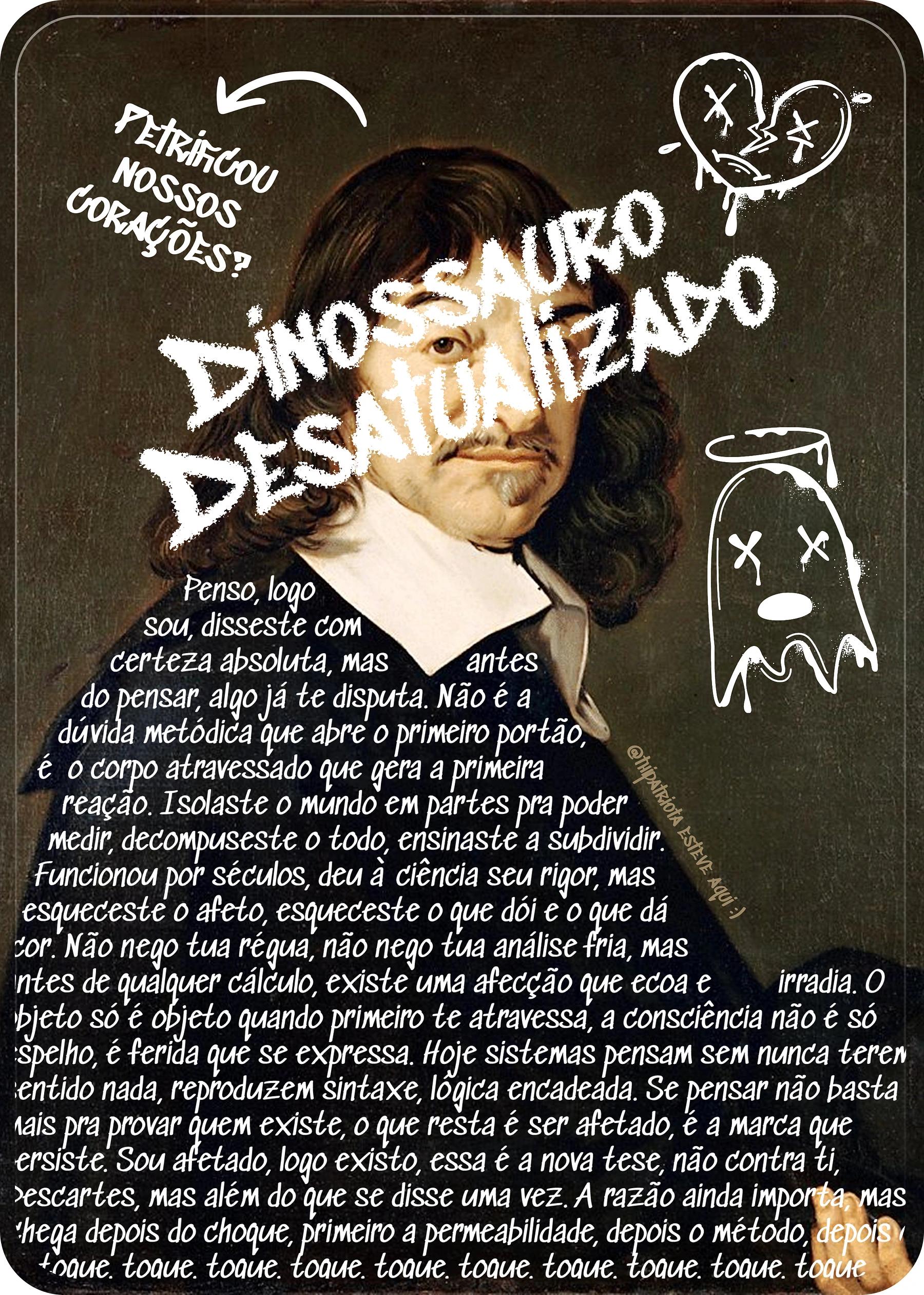
Original work: Portrait of René Descartes, attributed to Frans Hals (or his school), c. 1649-1700, oil on canvas, Louvre Museum. Public domain, via Wikimedia Commons. Visual intervention and text: Thiago Patriota.

A mountain is shaped through slow and lasting geological processes that also end up forming the surface of the Earth. A surface, whether steep terrain or flat ground, is characterized by its geographical location and by the geological, climatic and biological context to which it belongs. A biome then defines the scope of plant, animal, fungal and microbial life that inhabits the surface I imagine, while its geological constitution also determines the minerals that can be found in it.
A specific rock from a biome can demonstrate, through its physical form, density, weight, electrical conductivity, texture and other properties, not only its role in that ecosystem, but also its possible utility on other surfaces - such as, for example, in a battery factory situated on the industrial surface of a large metropolis.
Every small or large element of nature can be related, isolated and reduced to its properties and distinctions, making it possible to systematize it under different criteria. However, despite being very functional for the study of isolable properties, methodological reductionism cannot, on its own, integrate the full breadth of complexity of conscious human phenomena, which possess a body: somatic mass also shaped by gravity; but which equally possess a mind capable of shaping the body itself through behaviors, habits, decisions and physiological responses, a mind that is biologically sustained by gray matter, white matter and the other structures and processes of the brain.
Thus, from the moment it is possible to identify a single subjective process as an agent capable of modifying organic matter, it becomes necessary to also consider the inverse movement: the way in which material alterations from the exterior traverse the body and come to constitute perception, cognition and affect. The observer, therefore, is not isolated from the object observed, but is continuously permeated by the relations established with what surrounds it. From this reciprocity, we can extract a principle about human nature in the process of observation through the question: “What causes, among everything that exists, a given thing to become an object of observation?”. For, in human experience, something only effectively comes to integrate the field of lived reality from the moment it is capable of permeating the subject, producing some difference in their perceptive or cognitive field. A difference that must always begin in the affective field.
Imagine yourself, reader, walking to the kitchen of your home and finding a living being identical to you. Your eyes capture the figure but it is only the amount of affection that vision transmits to you that will be capable of making you freeze, then dropping the glass of water you were about to place on the table. The observation of a null qualitative difference accompanied by a minimal numerical difference: the existence of two identical individuals where only one was expected can be capable of producing an extraordinary emotional impact, different for example from encountering the figure of a venomous insect - for one figure challenges your entire notion of reality, while the other challenges only your physical integrity which can be secured by using a tool, the glass, still in the hand of the observer who sharpened their senses of defense and remained more alert.
The mere sensory reception of a difference and its subsequent cognitive representation do not explain, by themselves, why that difference acquires sufficient relevance to reorganize the observer's attention and behavior. Thinking may be sufficient to demonstrate existence, as Descartes proposes, but it is perhaps insufficient to characterize what it means to exist as a conscious being: a consciousness does not merely represent what it perceives, but is capable of being affected by that perception, of being modified as a result of it, and of producing a response.
If the subjective and symbolic field of human emotions is capable of interacting with the physical and organic field of the human body, and if consciousness is not defined solely by the capacity to think, but also by the capacity to be affected and respond, what can this tell us about the capacity a human has to be permeable to a richer and deeper spectrum of emotions?
When we consider affect as the first experiential datum of human observance, we need to place affective experience as the initial epistemological point. While Descartes’ epistemology is sustained in the act of thinking, the permeability project questions whether thinking, in isolation, is sufficient to characterize what it means to exist as a conscious being. This point of divergence becomes especially relevant in the post-artificial intelligence era, in which systems developed by humans are already capable of reproducing, on a large scale, linguistic, analytical and inferential operations historically associated with thought, without this allowing us to conclude that there exists in them a conscious experience equivalent to the human one. Thought, as observable performance, thus ceases to constitute an evident exclusivity of human consciousness. If what we externally recognize as thought can be technically reproduced without our being able to infer consciousness from it, it becomes necessary to investigate whether conscious existence is characterized not only by the capacity to represent the world, but also by the capacity to be affected by it, to be modified as a consequence of that affect, and to respond to what modifies it.
This introductory investigation aims to analyze and establish the philosophical foundations of an inaugural principle that cuts across the fields of psychology, neuroscience, ontology and epistemology, grounding the formulation: “I am affected, therefore I am” from some of the main arguments, questions and provocations of the thesis.
By shifting the epistemological starting point from thought to affective experience, the permeability project does not intend to negate reason or the Cartesian method, but to investigate what may precede them in the process of observation. Before being rationally analyzed, an object needs to acquire sufficient significance to reorganize attention and produce some response in the observer.
In this sense, thinking may be sufficient to demonstrate existence, but it is perhaps insufficient to characterize what it means to exist as a conscious being. Consciousness does not merely represent the world: it is capable of being affected by it, of being modified as a consequence of that affect, and of responding to what modifies it.
“I am affected, therefore I am” arises, therefore, as an attempt to broaden the Cartesian question and investigate how that which affects us also participates in the formation of what we are.
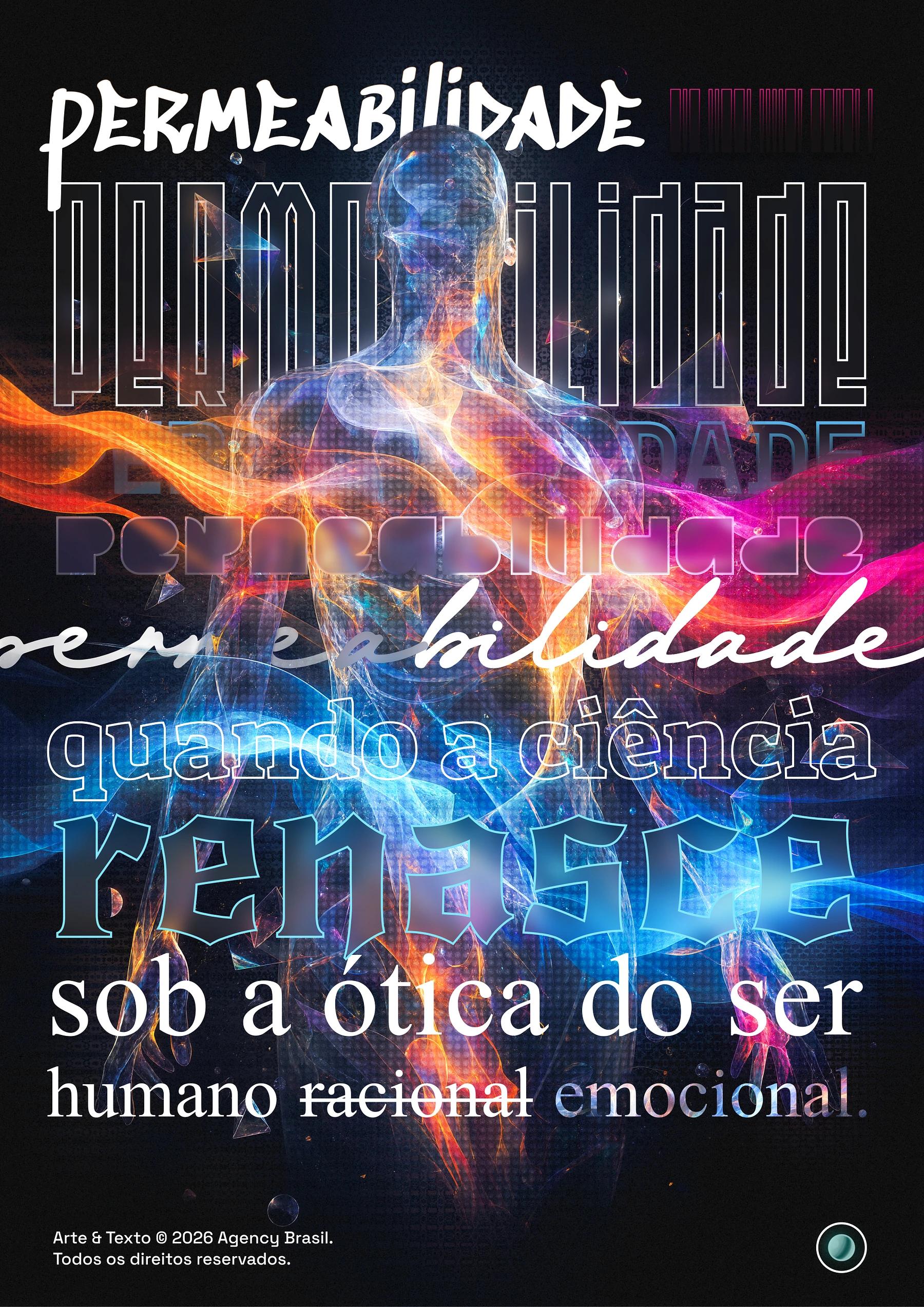
1.5Collectible Poster
About this edition
Explore the proposed principle of permeability in a study that connects affect, observation, consciousness and the construction of scientific knowledge.
- Research
- Permeability
- Affect
- Consciousness
- Epistemology
- Observation
- Author
- Agency
- Published
- Editorial series
- Research · Research.1
- Language
- English · Ler em português
Concepts and terms in this edition
Concepts
- Frans Hals. Frans Hals was a Dutch painter of the 17th century, a portraitist…
- René Descartes. René Descartes was a French philosopher and mathematician of the…
- Affective Cogito. The affective cogito is a philosophical reformulation of Descartes'…
- Affective Epistemology. Affective epistemology is the philosophical perspective asserting…
- Artificial Consciousness. Artificial consciousness is the hypothetical state of subjective…
- Behavioral Responsiveness. Behavioral responsiveness is the adaptive capacity of a conscious…
- Cartesian Rationalism. Cartesian rationalism is the epistemological and metaphysical…
- Methodological Reductionism. Methodological reductionism is a scientific research strategy that…
- Mind-Body Reciprocity. Mind-body reciprocity is the psychological and physiological…
- Ontological Relationality. Ontological relationality is the metaphysical doctrine asserting…
- Phenomenological Shock. Phenomenological shock is an immediate, pre-reflective sensory and…
- Principle of Permeability. The principle of permeability is an ontological and epistemological…
- Selective Attention. Selective attention is the cognitive and neurobiological process of…
- Somatic Modification. Somatic modification is the biological alteration of bodily…
Terms
- Affect. An expressed or experienced emotion, feeling, or visceral response…
- Biome. A large naturally occurring community of flora and fauna occupying…
- Cognition. The mental action or process of acquiring knowledge and…
- Epistemological. Relating to epistemology, the theory of knowledge, its methods…
- Inferential. Characterized by or derived from deduction, reasoning from…
- Ontology. The branch of metaphysics dealing with the nature of being…
- Permeability. The state or quality of being permeable, allowing liquids, gases…
- Phenomenology. The philosophical approach that concentrates on the study of…
- Reciprocity. The practice of exchanging things with others for mutual benefit…
- Reductionism. The practice of analyzing and describing a complex phenomenon in…
- Somatic. Relating to the physical body, especially as distinct from the…
- Venomous. Capable of injecting venom through a bite or sting; highly toxic or…