 Issue.3Explore editorials
- issue.0 - Row Your Boat, Sailor.English
- issue.1 - I Owe You an Apology.English
- issue.2 - Impressed.English
- Issue.3 - Design in CrisisEnglish
- Issue.4 - Leadership in CrisisEnglish
- Issue.5 - Coffee Machines in CrisisEnglish
- Issue.6 - Time & Consumer Psychology In CrisisEnglish
- Issue.7 - Economy in Crisis Pt.1English
- Issue.8 - Copywriting for CrisisEnglish
- Issue.9 - MetarealityEnglish
- Issue.10 - NumbersEnglish
- Issue.11 - A Catalyst for EconomyEnglish
- Issue.12 - SemioticsEnglish
- Issue.13 - AûsubEnglish
- Issue.14 - ZephyrEnglish
- Issue.15 - 10.000 ImpressionsEnglish
- Issue.16 - GandolfiniEnglish
- Issue.17 - SportsmanshipEnglish
- Issue.18 - 20.000 ImpressionsEnglish
- Issue.19 - FlusserEnglish
- Issue.20 - Truth?English
- Issue.21 - 1.000 Followers 🎉English
- Issue.22 - You are a CatalystEnglish
- Issue.23 - A Brazilian Model?English
- Issue.24 - Boiling Red CobaltEnglish
- Issue.25 - Interfaces as CosmologyEnglish
- Issue.26 - PharmakonEnglish
- Issue.27 - The Roman EmpireEnglish
Design in Crisis
To care for design or not care for design? That is the question.

12 min read
3.1The new Beating Heart of Your CultureAnd I’m not talking about ESG and Sustainability. (Yet.)
design //
noun and verb
As a noun, it means—among other things “intention,” “plan,” “intent,” “aim,” “scheme,” “plot,” “motif,” “basic structure,” all these (and other meanings) being connected with “cunning” and “deception.” As a verb (“to design”), meanings include “to concoct something,” “to simulate,” “to draft,” “to sketch,” “to fashion,” and ‘to have designs on something.”
“About the Word Design” by Vilém Flusser
To design is to create something new. It is as simple as that, but creating something regards always creativity, so design shouldn’t under any circumstance be underestimated. Do you know who else is believed to have this same capacity of creation? God.
Please calm your nerves before you burst into stars and planets of anger like a big bang. I’m just trying to raise an important argument, and get your attention, especially because we are on a boat that lacks paddles that need to be… created. Designed. Let’s create these paddles together. But first, here’s a short story.
For clarity, whenever I say “designer” in this issue, I refer to not only a visual designer but also a writer: creatives. Whenever I say “client”, that can also be read as manager.
Doctor - General Physician
Designer - Worried Patient
*Patient sits on the chair
* Patient slams the door.

3.2The Substance of DesignWhy Design is Important for Your Culture
That story was absurd, wasn’t it?
Yet, it is a glimpse of how it feels to be a designer in the post-modern era.
Why?
Because that is exactly what tends to happen. As designers (communication doctors), clients come to us with a symptom (a problem), and when we give the diagnostic (the solution), it is rejected.
It is rejected because designers are not taken seriously. When something needs to be created, you need a creative. Whether it is a text or an image, you need copywriters or designers to create it. Creatives.
“Hey, anyone can write a headline or design an e-commerce banner, Thiago.” Someone yells from another boat.
Hey, I agree with you sailor, and I add to that: everybody should create. Not just because creating tends to be therapeutic. But also because if the new approach to marketing we have been discussing has autonomy as its foundation, that means that you should also be able to create. Regardless of your title or position.
Everybody should create because, in 2023, everybody can create. Tools that were inaccessible or extremely hard to master in the past are now available thanks to new technologies. We have Canva to easily manipulate images and graphics, Figma for wireframes and interfaces, Capcut to edit videos and audio, ChatGPT to help with research and ideas for writing, Grammarly to help with… Grammar. Unsplash to help with stock images, and Pixabay for stock videos. There are also asset libraries like Elements Envato that put everything together if you want to go pro and create more high-end materials.
Think about an intern
Now think about a CEO.
Now think about an intern who turned into a CEO by investing years of dedication into a company and climbing up the ladder with determination and results.
This brilliant person probably wore all types of hats and went through every single department and function of this company, this person knows the company’s processes, finances, operations, and culture from the inside out. This person is autonomous, as every founder and leader should be.
So putting on a creative hat for one day can help you understand why your designers are critically important to your company.
Creating is in fact accessible to anyone.
But creating aesthetic things is not. It takes a lot of time to master. As with any profession. (Read Picasso’s Napkin story in this Issue)
Because when a project lands on a designer’s desk, this person will devour the briefing so that the target audience is identified and the vision of the client is understood.
The creative process starts, it’s a mix of feelings. Sometimes even a little scary because there is no way to know we will be able to deliver what is needed. Can you handle this anxiety?
Think about this, when you create something, absolutely anything is possible and this opens a very big gap for getting it wrong as well.
Fortunately, designers are trained to deeply perceive feelings and words. This is why they tend to be sensitive and the reason why they usually get it right. A supernatural capacity for synthesis
The core problem is that after all the time spent working on something with the client’s audience in mind, projects are still rejected out of personal judgment. Because the client was having a bad day and didn’t like the tone of the blue or the adjective or noun used in the title, which made him hate the whole piece, which could be salvaged.
“This doesn’t work. Design me another paddle.”
And the paddle is discarded after hours of research and work, after years of experience in designing paddles. Why?
Because the alignment wasn’t perfect, the message wasn’t clear, there was no harmony between the supplementary colors and the main colors of the brand, there was no contrast between the text and the background, the photo used wasn’t inclusive enough, the call for action was missing, the dimension of the image was poor in pixel density, the menu button was in a weird place.
These weren’t the reasons. Because maybe the designer got all of this right.
The reason was that there was too much traffic earlier in the morning, which jeopardized the whole day, for the designer, the client, and the company.
The reason was understated because design and aesthetics deal with feelings and it’s much easier to mix them when reviewing a project.
And we find ourselves still lacking paddles. With a tsunami getting closer.
The milk has been spilled again. Acknowledge it. Clean it.
Who’s to blame?
The doctor up there?
Surely not.
Then the designer?
No.
The client?
No.
The culture?
Precisely.
Because the post-modern corporate culture aims for production output and the revenue comes from the quantity, not the quality. But this system is broken. As is the economy. Scientifically defending this claim would make this issue tirelessly dense, but I already did so here.
If you put quantity in front of quality you may find yourself with dozens, hundreds, or thousands of paddles. But will any of them work?
In the past, they would. But the sea is different. It is agitated and paddles get broken very fast. So we need an unbreakable paddle. A sustainable paddle. An ESG paddle.
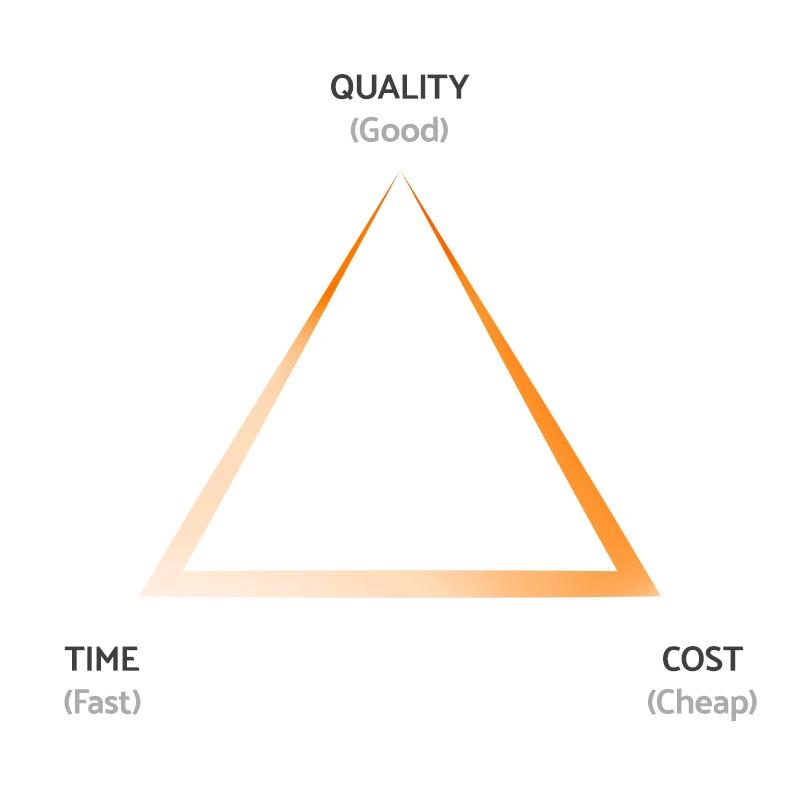
Pick no more than 2.
This is a very simple marketing exercise that has been long forgotten but it is the perfect tool for whenever you start a new creative project. When you need to design a new product or a new campaign. You can only pick 2 ends of the triangle, no more than that. This exercise will help you perceive how you currently see the culture of design.
Fast + Cheap: You prioritized quantity and you will get many shallow paddles. You can try to sell them but the consumers will know they are cheap. You are careful because you don’t like taking risks.
Fast + Good: You prioritized quality but had to invest a lot of money to manufacture the paddle fast. You are bold because you made a bet.
Good + Cheap: You prioritized quality while saving money, and you had the patience to carefully make a single trustworthy paddle. You are a zen human being and for that I admire you! ☯
So how do you intend to treat design from now on?
This chapter got much more extensive than planned but the message at its core is as follows:
- If you give more trust and creative freedom to your designers, you will realize that they can always make you the right paddle.
- Creatives should judge the quality of paddles because they understand the process to make them and the aesthetics your audience is looking for.
- Creatives should be responsibilized for the results of the paddle and may grow their creative capacities by doing so.
A unique paddle shall be made.
And you will feel represented.
As long as autonomy is given to your creatives.

3.3The Price of AestheticsPicasso’s Napkin - Short Story
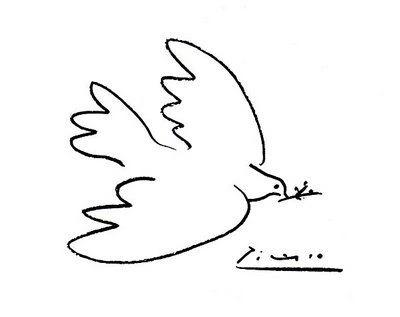
Picasso had one particular thing in common with some of us. He liked coffee.
Hey, are you drinking some coffee now? That is very Picasso of you.
Due to that, he used to hang out in cafes around Barcelona. Sometimes in the search of some peace of mind and inspiration, sometimes to meet with some artist friends.
On this particular day, of a particular month, of a specific year in a particular bohemian corner of beautiful and sunny Barcelona, Picasso decided to meet this new humble cafe that had just recently opened its doors, he picked a table in the very corner and there he stood in peace thinking about life while sipping a delicious, aromatic and earthy cup of coffee.
Some peace he wanted, some peace he didn’t find.
At a given moment a fan of his spotted him on the corner and couldn’t lose that opportunity to meet such a famous artist that she loved so much.
She approached him and this is how a bird told me it played out:
— Picasso?
— Hello there.
— Pablo Picasso?
— Yes ma’am. that’s me.
— I can’t believe this. I am your biggest admirer. Said the woman as she perceived some impatience in his expression.
— Well, thank you so much! Said Picasso wanting to get back to his coffee and mind voyage.
— I don’t want to be a bother, but can you just sign this napkin for me? Or maybe make a quick sketch?
Picasso politely agreed, promptly created a drawing, and handed back the napkin — but not before asking for a million Francs. (Approximately 1 million dollars back then)
In shock, the lady replied. — How can you ask for so much? It took you five minutes to draw this!
— No. Picasso replied. — It took me 40 years to draw this in five minutes.
This is such a powerful story because resonates with all creative professionals. But it is a story that goes for both sides.
Creatives, your craft can’t be priced entirely with logic. The value of your work resides behind how you position yourself on behalf of your experience and capacity. You should be in a place where you feel comfortable growing. Remember: A hole teaches you to fit, a seed teaches you not to fit in itself.
Managers and clients, you should trust the experience of your creative professionals. I’m not saying that design is art, but sometimes, designers can be in fact, artists.
A creative factory of million-dollar-worthy paddles.
That gets discarded.
3.4Pandora’s BoxA Fresh Digest on my latest discoveries and some other things.
3.4.1In the Lenses of Thi
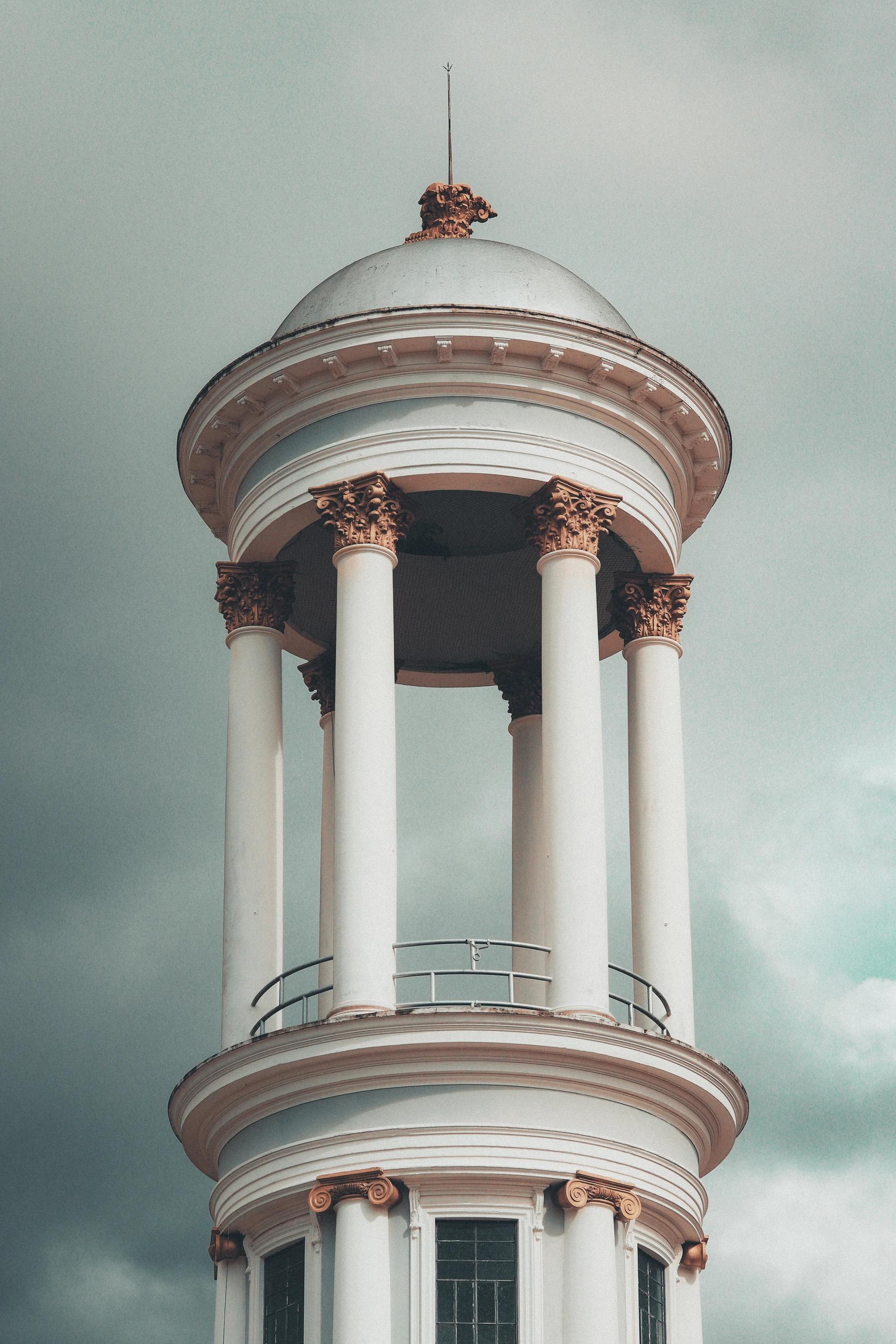
Curitiba, 2022.
This was one of my favorite shots from the past year. Even though the sky was clouded and gray on that day, the perfect lines of this architectural feat immediately called my attention and I had to capture it. Captured it was, forever turned into pixels on a digital and binary JPEG file, pixels in data, data in pixels, now forwarded to you!
3.4.2Chords 🎶
With so much talking about creativity, it wouldn’t feel right to end this issue without sharing some music. Ideas don’t come out of anywhere, inspiration comes from consuming artistic expressions.
New ideas are rarer though because they tend to come from new references. If you always listen to the same old music, it is as if you are stuck in a box. So it is important to try new things, regardless if you like them or not. An open mind is a like a nest for new ideas to land.
That which is metamodern captures the perfect essence between what is nostalgic and what is new, hence, we need both.
3.5Feedback Mural
Some amazing feedback from Issue.2! Thank you again for all the support.
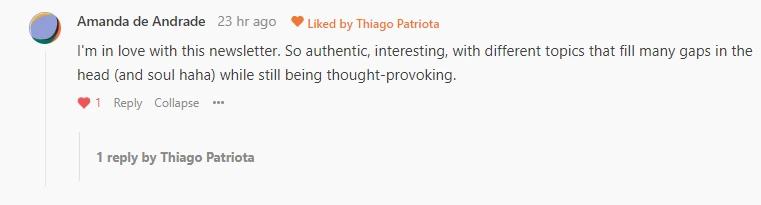
Amanda is a voiceover artist deeply passionate about her craft! If you need a unique voice for a commercial, she can most definitely help you.

Portuguese for “Dense”. I love that!
About this edition
Explore design as a force in culture and communication, from its underlying intentions to the price of aesthetics and the choices that make a message clear.
- Edições
- Design
- Aesthetics
- Corporate culture
- Visual communication
- Creativity
- Author
- Thiago Patriota
- Published
- Editorial series
- Edições · Issue.3
- Language
- English · Ler em português